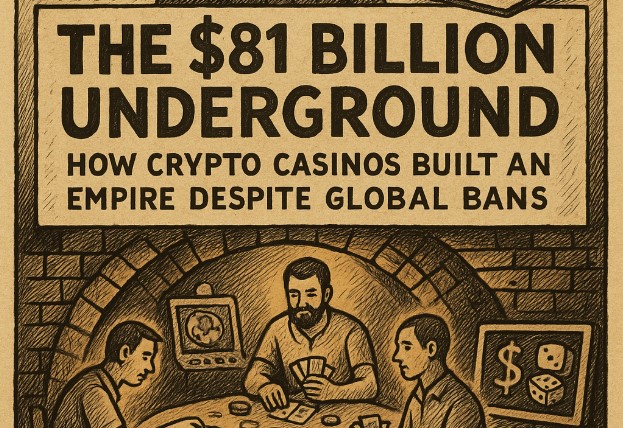
The numbers are staggering and undeniable: cryptocurrency casinos generated over $81 billion in revenue during 2024, creating what amounts to a parallel gambling economy that operates largely beyond the reach of traditional regulators. This figure, compiled by anti-online-crime platform Yield Sec and reported by the Financial Times, represents more than just impressive growth—it signals a fundamental shift in how people gamble, where they gamble, and who controls the gambling industry.
Discover useful insights, resources, and guides when you visit here. Stay informed with the latest updates designed to provide value and clarity for your needs
To put this in perspective, the entire Nevada gaming industry generated approximately $15 billion in revenue in 2023. The crypto casino sector, operating primarily in regulatory gray zones and outright banned territories, now generates more than five times that amount annually. This isn’t just growth—it’s the emergence of an entirely new gambling ecosystem that has evolved faster than regulators can respond.
The Unstoppable Rise of Digital Gambling
The trajectory of crypto casino growth defies conventional business logic. While traditional industries struggle when faced with regulatory restrictions, crypto gambling platforms have thrived precisely because of them. The $81.4 billion figure represents a five-fold increase since 2022, a growth rate that would be remarkable in any unrestricted market, let alone one facing active government opposition.
This explosive growth occurred while major jurisdictions including the United States, United Kingdom, China, and European Union maintained strict prohibitions on crypto gambling platforms. Rather than stifling growth, these restrictions appear to have created an underground demand that far exceeds what anyone anticipated.
“What we’re witnessing isn’t just market growth—it’s the emergence of an entirely parallel gambling economy,” explains Mark Taylor, early bitcoin adopter and casino analyst on casino whizz. “Traditional operators spent decades building compliance frameworks and regulatory relationships, but crypto casinos bypassed all of that infrastructure and went straight to serving customer demand. The result is a $81 billion market that exists almost entirely outside conventional oversight.”
The driving forces behind this growth extend beyond simple regulatory arbitrage. Crypto casinos offer several advantages that traditional online casinos cannot match: near-instantaneous transactions, minimal KYC requirements, provably fair gaming systems, and the ability to gamble with appreciating assets. Players can deposit Bitcoin earned through various means and potentially withdraw more valuable cryptocurrency, creating a unique value proposition that traditional casinos struggle to replicate.
Stake: The $4.7 Billion Proof of Concept
Perhaps no single platform better illustrates the crypto casino phenomenon than Stake, which reported gross gaming revenue of $4.7 billion in 2024—an 80% increase from 2022. These numbers place Stake in direct competition with traditional gambling giants like Entain ($5 billion revenue) and within striking distance of industry leader Flutter ($14 billion revenue).
What makes Stake’s achievement particularly remarkable is its operational model. Unlike traditional operators that rely on licensed, regulated markets with extensive compliance overhead, Stake operates primarily through cryptocurrency transactions and offshore licensing structures. This approach eliminates many of the costs that burden traditional operators while providing access to global markets regardless of local gambling laws.
Stake’s platform demonstrates the full spectrum of crypto gambling offerings: traditional casino games including blackjack, roulette, and slots alongside comprehensive sports betting markets. The platform’s user experience rivals or exceeds that of many licensed operators, with faster transaction processing and more flexible betting options.
The platform’s success hasn’t come without challenges. In September 2023, Stake suffered a $41 million hack attributed by the FBI to North Korea’s Lazarus Group, highlighting the security risks inherent in crypto gambling operations. However, the platform’s ability to quickly recover and continue growing suggests that users view such risks as acceptable trade-offs for the benefits crypto gambling provides.
The Underground Infrastructure
The crypto casino ecosystem operates through a sophisticated infrastructure that enables players to circumvent geographic restrictions and regulatory barriers. This underground economy has developed its own systems, services, and marketplaces that operate parallel to traditional gambling channels.
VPN-Enabled Access Networks
Virtual Private Networks have become the primary gateway for players in restricted jurisdictions to access crypto casinos. Unlike traditional online gambling, where payment processing restrictions often provide effective enforcement mechanisms, crypto casinos only need to verify that users appear to be connecting from permitted locations. VPN technology makes this trivial to circumvent.
The VPN access model has created an entire educational ecosystem. Influencers and online guides provide detailed tutorials on accessing blocked gambling sites, often monetized through affiliate relationships with both VPN providers and crypto casinos. These guides have become increasingly sophisticated, covering everything from selecting appropriate VPN servers to managing cryptocurrency wallets for gambling purposes.
Ready-to-Gamble Account Markets
Perhaps the most striking development in crypto casino access is the emergence of pre-verified account markets. Users in jurisdictions where they can legally access crypto casinos create accounts, complete verification processes, and then sell these “ready-to-gamble” accounts to users in restricted territories.
Reports indicate these accounts sell for as little as $10 on social media platforms, including Facebook. This pricing suggests massive demand for crypto casino access, as buyers are willing to assume the risks associated with using someone else’s verified identity for gambling purposes.
The account marketplace reveals the inadequacy of current regulatory approaches. Traditional KYC (Know Your Customer) requirements, designed to prevent money laundering and ensure responsible gambling, become meaningless when accounts can be readily purchased and shared. This underground market effectively nullifies one of the primary regulatory tools used to control online gambling.
The Technology Advantage
Crypto casinos possess several technological advantages that traditional operators struggle to match, creating competitive moats that extend beyond regulatory arbitrage.
Blockchain-Based Provably Fair Gaming
Traditional online casinos ask players to trust that their random number generators are fair. Crypto casinos can provide cryptographic proof that games are fair through blockchain-based verification systems. Players can independently verify that each bet outcome was generated fairly, creating unprecedented transparency in an industry historically plagued by trust issues.
This technological advantage addresses one of gambling’s fundamental problems: the house’s ability to manipulate outcomes. While regulatory oversight attempts to ensure fairness in traditional casinos, crypto casinos can provide mathematical certainty through transparent algorithms and blockchain verification.
Instant Settlement and Global Access
Cryptocurrency transactions enable instant deposits and withdrawals regardless of banking relationships or payment processor restrictions. Traditional online casinos often struggle with payment processing, especially for international customers, and typically require several days for withdrawal processing.
Crypto casinos can settle transactions in minutes rather than days, providing a user experience that traditional operators cannot match within existing financial infrastructure. This speed advantage becomes particularly pronounced for high-frequency bettors and professional gamblers who value quick access to their funds.
Portfolio Integration and Asset Appreciation
Crypto casino users can gamble with assets that may appreciate independently of gambling outcomes. A player might deposit Bitcoin, lose some gambling sessions, but still profit overall if Bitcoin’s value increases during their gambling period. This dynamic creates unique risk/reward profiles that don’t exist in traditional gambling.
Some crypto casinos have integrated directly with DeFi protocols, allowing users to earn yield on their account balances while not actively gambling. These features blur the lines between gambling, investing, and yield farming, creating hybrid experiences that traditional casinos cannot replicate.
Regulatory Whack-a-Mole
Government responses to crypto casino growth illustrate the challenges regulators face when dealing with decentralized, borderless technologies. Traditional regulatory approaches—licensing requirements, payment processor restrictions, ISP blocking—prove ineffective against platforms designed to operate outside conventional financial and legal systems.
The Enforcement Problem
Crypto casinos typically operate through complex offshore structures that place them beyond the reach of most national regulators. Even when authorities successfully shut down one operational entity, new ones can quickly emerge using the same underlying technology and cryptocurrency infrastructure.
The decentralized nature of blockchain technology makes comprehensive enforcement nearly impossible. Regulators can block specific websites or platforms, but they cannot block the underlying cryptocurrency networks that enable these platforms to operate.
Jurisdictional Arbitrage
Crypto casinos exploit regulatory arbitrage by incorporating in jurisdictions with favorable gambling laws while serving customers globally through cryptocurrency transactions. This approach renders traditional concepts of gambling regulation—which rely on controlling operators within specific territories—largely obsolete.
Some crypto casinos operate entirely through smart contracts and decentralized protocols, eliminating identifiable corporate entities that regulators could target. These fully decentralized platforms represent the next evolution of crypto gambling, potentially making regulatory enforcement even more challenging.
The Innovation Dilemma
Regulators face a fundamental dilemma: aggressive enforcement against crypto casinos may drive innovation further underground while failing to protect consumers, but acceptance risks legitimizing platforms that operate outside traditional consumer protection frameworks.
Some jurisdictions are exploring regulated crypto gambling frameworks that would bring these platforms within legal oversight while preserving their technological advantages. However, the global nature of cryptocurrency makes unilateral regulatory approaches inherently limited in effectiveness.
Market Dynamics and Competitive Landscape
The crypto casino market operates under different competitive dynamics than traditional gambling, creating opportunities for rapid growth and market capture that would be impossible in regulated environments.
Network Effects and User Acquisition
Crypto casinos benefit from network effects that traditional operators cannot access. Users who profit from crypto gambling often become evangelists for platforms, sharing strategies and access methods through social media and online communities. This organic marketing proves far more effective than traditional advertising, especially in markets where gambling advertising is restricted.
The technical barriers to accessing crypto casinos create a self-selecting user base of more sophisticated, higher-value customers. Users willing to learn about VPNs, cryptocurrency wallets, and blockchain technology often represent more valuable customers than casual players attracted through traditional marketing.
Affiliate and Influencer Marketing
Crypto casino affiliate marketing operates largely outside traditional advertising restrictions, enabling platforms to reach audiences through gaming influencers, cryptocurrency content creators, and social media personalities. These marketing channels often prove more effective at acquiring customers than traditional gambling advertising while avoiding regulatory scrutiny.
The integration of affiliate marketing with cryptocurrency creates unique incentive structures. Affiliates can be paid in cryptocurrency, share in platform tokens, or receive revenue sharing arrangements that appreciate with crypto prices. These models create stronger partnerships between platforms and marketers than traditional fixed-commission structures.
Platform Innovation and User Experience
Without regulatory constraints on game types, betting limits, or platform features, crypto casinos can innovate faster than traditional operators. They regularly introduce new game types, betting mechanisms, and user features that would require regulatory approval in licensed markets.
This innovation advantage creates competitive pressure on traditional operators, who must balance innovation with compliance requirements. Many features pioneered by crypto casinos eventually make their way into regulated markets, but often years after their initial introduction.
The Underground Economy’s Surface Impact
The crypto casino economy increasingly intersects with mainstream financial markets and traditional gambling operators, creating spillover effects that extend far beyond the platforms themselves.
Cryptocurrency Market Integration
Crypto casino activity significantly impacts cryptocurrency markets through massive daily transaction volumes. Major platforms process billions of dollars in cryptocurrency transactions annually, creating substantial demand for popular gambling tokens and stablecoins.
Some cryptocurrencies have gained primary adoption through gambling platforms, with their value closely tied to the success of associated crypto casinos. This creates feedback loops where successful gambling platforms drive cryptocurrency adoption, which in turn enables more gambling activity.
Traditional Industry Response
Traditional gambling operators increasingly recognize crypto casinos as serious competitors for customer attention and gambling spend. Some licensed operators have launched cryptocurrency-enabled platforms in permitted jurisdictions, attempting to capture demand for crypto gambling while maintaining regulatory compliance.
The success of crypto casinos has also influenced traditional platform development, with many operators adding cryptocurrency payment options and blockchain-based verification systems to compete with crypto-native platforms.
Financial Services Integration
Mainstream financial services increasingly interface with crypto gambling through cryptocurrency exchanges, payment processors, and wallet providers. While most major financial institutions maintain policies against gambling-related transactions, the pseudonymous nature of cryptocurrency makes enforcement challenging.
Some cryptocurrency exchanges and wallet providers have developed specific features for gambling customers, creating infrastructure that supports the crypto casino ecosystem while maintaining plausible deniability about gambling-specific use cases.
User Demographics and Behavioral Patterns
The crypto casino user base exhibits distinct characteristics that differentiate it from traditional gambling demographics, providing insights into future market evolution.
Technological Sophistication
Crypto casino users typically possess higher technological literacy than traditional gamblers, enabling them to navigate complex access mechanisms and understand blockchain-based gaming systems. This sophistication translates into more informed gambling behavior and higher tolerance for platform complexity.
The technical requirements for accessing crypto casinos create natural barriers that filter for more committed gamblers. Users willing to learn about VPNs, cryptocurrency wallets, and blockchain verification represent a more engaged customer segment than casual traditional casino visitors.
Risk Tolerance and Investment Mentality
Many crypto casino users approach gambling with an investment mindset, viewing potential cryptocurrency appreciation as part of their overall risk/reward calculation. This perspective creates different loss tolerance and betting behavior than traditional gamblers focused solely on game outcomes.
The overlap between cryptocurrency investing and crypto gambling creates users who may be more comfortable with volatility and longer-term risk exposure than traditional gamblers. These characteristics often translate into higher customer lifetime values for crypto casino operators.
Geographic Distribution and Access Patterns
Crypto casino usage correlates strongly with regions that have active cryptocurrency adoption but restrictive gambling laws. Countries with sophisticated internet infrastructure but limited legal gambling options often show disproportionately high crypto casino usage.
The global nature of crypto casino access creates user bases that span multiple time zones and regulatory environments, enabling platforms to maintain consistent activity levels throughout 24-hour periods. This global reach provides competitive advantages that traditional, geographically restricted operators cannot match.
Economic Implications and Future Outlook
The $81 billion crypto casino market represents more than a gambling phenomenon—it demonstrates how blockchain technology can create entirely new economic systems that operate independently of traditional regulatory frameworks.
Monetary Policy and Financial Surveillance
Crypto casino growth contributes to broader trends of financial de-centralization that challenge traditional monetary policy tools and financial surveillance systems. Large-scale gambling activity conducted entirely in cryptocurrency creates economic activity that remains largely invisible to traditional financial oversight.
The scale of crypto casino revenue suggests that significant economic activity now occurs outside traditional banking systems. This parallel economy may influence cryptocurrency adoption, monetary policy effectiveness, and financial stability in ways that regulators are only beginning to understand.
Innovation and Technology Development
Competition between crypto casino platforms drives rapid innovation in blockchain technology, smart contract development, and user interface design. Many technological advances pioneered in crypto gambling eventually find applications in other blockchain-based industries.
The substantial revenue generated by crypto casinos provides funding for continued technological development, creating positive feedback loops that accelerate innovation across the entire cryptocurrency ecosystem.
Regulatory Evolution and Industry Legitimacy
The success of crypto casinos may eventually force regulatory evolution toward frameworks that accommodate blockchain-based gambling while maintaining consumer protection. Some jurisdictions are already exploring “regulatory sandbox” approaches that allow crypto casino experimentation within controlled environments.
As traditional gambling operators increasingly adopt cryptocurrency features and crypto casinos mature their operational practices, the distinction between regulated and unregulated gambling may become less relevant than the distinction between centralized and decentralized platforms.
The Path Forward
The crypto casino industry’s rapid growth from virtually nothing to $81 billion annual revenue demonstrates the power of combining technological innovation with unmet market demand. This growth occurred despite active government opposition, suggesting that the underlying drivers are stronger than regulatory resistance.
The future of crypto gambling likely depends on several key factors: regulatory adaptation to blockchain technology, continued innovation in platform features and user experience, integration with mainstream financial systems, and the broader adoption of cryptocurrency for everyday transactions.
What seems certain is that the crypto casino phenomenon represents more than a temporary arbitrage opportunity. It demonstrates how blockchain technology can create new economic systems that operate outside traditional regulatory frameworks while serving real user demands that existing systems fail to address.
The $81 billion question isn’t whether crypto casinos will continue to grow—it’s whether traditional gambling industries and regulatory systems can adapt quickly enough to remain relevant in an increasingly decentralized world. The answer will likely determine not just the future of gambling, but the broader relationship between innovation, regulation, and economic freedom in the digital age.