Have you ever tried a hairstyle or pair of glasses that looked great on someone else but somehow looked completely different on you?
The difference may have less to do with the style itself and more to do with facial proportions.
Understanding your face shape can provide a useful starting point when choosing hairstyles, glasses, facial hair, makeup techniques, and even clothing necklines. The challenge is figuring out your actual face shape rather than relying on a quick guess from a mirror.
Fortunately, identifying your face shape does not have to be complicated.
Why Face Shape Matters
Your face has its own combination of length, width, cheekbone prominence, forehead proportions, and jaw structure. These characteristics create the overall outline that people commonly describe as a face shape.
Face shape isn’t a measure of attractiveness. Instead, it is a practical way to describe facial geometry.
Once you understand your proportions, you can experiment with styles that either complement those proportions or create visual balance.
For example, someone with a long face may prefer styles that add visual width, while someone with a wider or rounder face might experiment with styles that introduce more vertical structure.
The Main Face Shape Categories
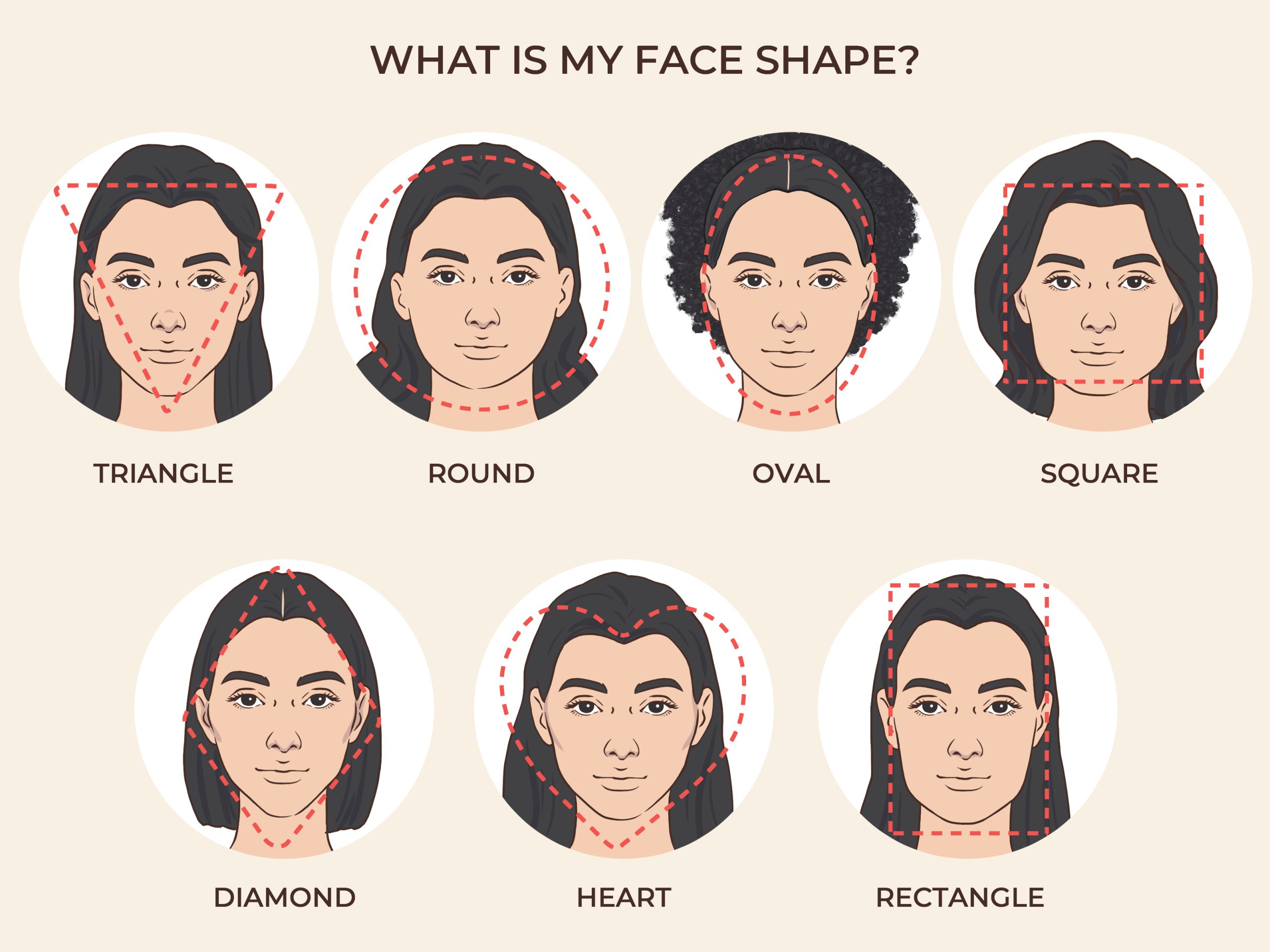
Although different guides use slightly different classification systems, eight categories are particularly useful:
- Oval: Generally longer than wide, with cheekbones providing much of the width and a gently tapered jaw.
- Round: Relatively similar in length and width, usually with a softer jawline.
- Square: More compact proportions combined with a noticeably angular jaw.
- Oblong: A longer face with relatively consistent width and a softer jaw contour.
- Rectangle: A longer face combined with a stronger, more angular jaw.
- Heart: A broader upper face that narrows toward the chin.
- Diamond: Prominent cheekbones with narrower forehead and jaw areas.
- Triangle: A comparatively broad jaw with a narrower forehead.
The important point is that these categories are not rigid scientific classifications. They are commonly used styling categories, and individual faces can sit between two types.
Look at Proportions, Not Just the Outline
One of the biggest mistakes people make is trying to identify their face shape from a quick visual glance.
Instead, consider four measurements:
Face Length
This is the distance from the upper forehead or hairline area to the bottom of the chin.
Face length is particularly useful because it helps distinguish shorter, more compact faces from longer face shapes.
Forehead Width
Measure the widest area across the forehead.
A relatively wide forehead combined with a narrower jaw can point toward a heart-shaped facial structure.
Cheekbone Width
The cheekbones often represent the widest part of an oval or diamond-shaped face.
Finding the widest point across the cheekbones gives you an important comparison against your forehead and jaw measurements.
Jaw Width
Your jaw measurement helps distinguish several similar-looking categories.
The actual contour matters too. A softer, curved jaw can produce a different classification from an angular jaw even when the overall measurements are similar.
A Simple Way to Find Your Face Shape
If you want to do the process yourself, start by pulling your hair completely away from your face.
Stand directly in front of a mirror and keep your head level.
Then ask yourself:
- Is my face significantly longer than it is wide?
- Which area is widest: forehead, cheekbones, or jaw?
- Does my jaw curve smoothly or form noticeable corners?
- Does my chin appear broad, narrow, or pointed?
These questions can quickly narrow down the possibilities.
However, visual estimation has limitations. Small differences can be difficult to judge accurately, particularly when two face shapes share similar proportions.
Use a Photo-Based Face Shape Detector
A photo analysis tool can make the process considerably faster.
The Face Shape Detector analyzes facial landmarks and evaluates your proportions against eight face shape categories. It can work from a front-facing photograph, use your camera, or let you enter your own measurements. The result includes the closest match and the other shape scores, rather than simply giving you one unexplained label.
The tool analyzes four major measurements:
- Face length
- Forehead width
- Cheekbone width
- Jaw width
It also considers jaw contour, which is particularly useful when distinguishing categories such as round versus square or oblong versus rectangle.
How to Take a Better Face Shape Photo
The quality of your photo can influence the result.
For a more useful measurement:
Pull your hair back. Hair can hide the forehead and sides of your face.
Keep your head level. Tilting your chin upward or downward changes the apparent length of your face.
Use a neutral expression. Smiling can change the visible width around the cheeks.
Remove glasses if possible. Frames can cover areas used for facial measurements.
Avoid an extremely close selfie. Wide-angle smartphone lenses can exaggerate features closer to the camera.
Use even lighting. Strong shadows can make the outline of your face harder to identify.
The live detector specifically recommends a front-facing image with the hair fully back, glasses removed, a level chin, and a neutral expression.
Prefer Measuring Instead of Taking a Photo?
A manual approach can be useful if you want greater control over the measurement points.
You’ll need a flexible measuring tape and four numbers:
- Face length
- Forehead width
- Cheekbone width
- Jaw width
Make sure every measurement uses the same unit. You can use centimeters or inches; consistency matters more than the particular unit.
The Face Shape Calculator provides a measurement-based alternative for people who would rather enter their facial measurements instead of analyzing a photograph.
This approach can also be helpful if a photo-based result seems borderline.
Why Two Face Shape Tests May Disagree
It can be surprising when two websites give you different results, but that does not automatically mean one of them is broken.
There is no single universal standard that defines every face shape category. Different tools can use different measurement points, ratios, thresholds, or numbers of categories.
Photography can introduce another source of variation.
Camera distance, lens characteristics, head position, lighting, hair placement, and facial expression can all affect the visible proportions.
This is one reason it is better to think of a face shape result as an informed geometric estimate rather than an absolute label.
What Does a Borderline Face Shape Mean?
Some people clearly fit one category. Others sit between two.
For example, you might have the length-to-width ratio associated with an oval face while having a jaw structure that resembles a square face.
A borderline result can actually be useful because it shows that your features share characteristics with more than one category.
Instead of worrying about which label is technically correct, look at the features that make up the result. Those characteristics are often more useful when choosing a hairstyle or other styling option.
Choosing Hairstyles Based on Face Shape
Once you know your general face shape, you can use it as a styling reference.
For longer face shapes, adding some visual width can help create balance. Depending on hair type, this might involve volume around the sides rather than emphasizing additional height.
For rounder faces, styles that introduce some height or structure can create a different visual proportion.
Square faces already have strong angular characteristics, so you can either emphasize those angles with structured styles or soften them with texture and movement.
Heart-shaped faces can benefit from considering the relationship between a wider forehead and narrower chin.
These are guidelines rather than rules. Hair texture, density, hairline, personal preference, and maintenance routine can be just as important as face shape.
Face Shape and Glasses
Face shape is also commonly considered when choosing eyeglass frames.
The goal isn’t necessarily to find a frame that is the exact opposite of your face. Instead, think about proportions.
Frame width, lens height, bridge fit, and the actual dimensions of the glasses can have a greater practical impact than simply choosing a frame because a chart says it is suitable for your face shape.
A well-fitting frame should sit correctly on your nose and temples before style considerations come into play.
Face Shape Is Only One Part of Your Appearance
It is easy to become overly focused on face shape after taking a test.
Remember that facial appearance involves much more than overall geometry. Your eyes, nose, lips, eyebrows, hairline, skin, hairstyle, expression, and individual features all contribute to how your face looks.
Face shape should therefore be treated as a useful styling reference rather than a score.
There is no “best” face shape, and a face shape result does not determine attractiveness.
A Practical Three-Step Approach
If you want a straightforward way to identify your face shape, use this process:
Step 1: Get a clean view of your face.
Pull your hair back, remove glasses, keep your head straight, and use neutral lighting.
Step 2: Compare your proportions.
Look at face length, forehead width, cheekbone width, jaw width, and jaw contour.
Step 3: Confirm the result.
Use a photo detector or manually measure your face if the visual result isn’t obvious.
This gives you a more reliable starting point than simply comparing your reflection with a face shape chart.
Final Thoughts
Finding your face shape doesn’t need to be complicated. The basic idea is to compare the length and width of your face, identify your widest areas, and consider the shape of your jaw.
The eight common categories—oval, round, square, oblong, rectangle, heart, diamond, and triangle—provide a useful framework for understanding those proportions.
Whether you use a mirror, measuring tape, or photo analysis, don’t worry if your result falls between two categories. Human faces vary considerably, and face shape categories are best understood as practical styling guidelines rather than rigid boxes.
Once you know your approximate face shape, you can use that information as one factor when exploring hairstyles, eyewear, grooming, makeup, and other personal style choices.