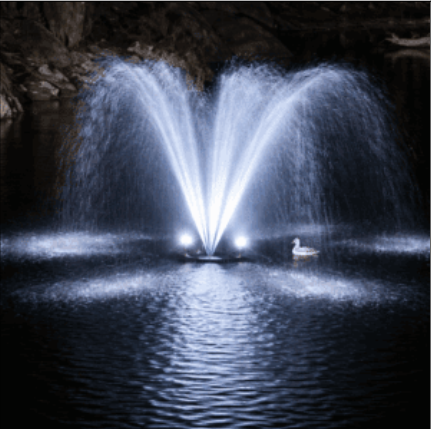
A pond can look attractive while still suffering from stagnant areas, uneven oxygen distribution, or limited water movement. A floating water fountain addresses these concerns by drawing pond water through a submerged pump and directing it upward through a spray nozzle. As the water returns to the surface, circulation and aeration improve throughout the surrounding area. This combination of visual appeal and functional water movement makes floating fountains useful for residential ponds, landscaped water features, farm ponds, and larger aquatic environments. Friendly Fountains offers multiple fountain configurations designed around different flow capacities and operating requirements.
How Floating Fountains Move and Aerate Water
Floating water fountain systems operate from a platform positioned on the pond surface. The pump draws water upward and forces it through an interchangeable nozzle, creating a defined spray pattern. Water falling back into the pond promotes surface agitation and helps introduce oxygen into the water.
The floating design also allows the fountain to remain positioned on the water surface as water levels change. This can be useful in ponds where maintaining a consistent installation position with fixed structures would be difficult. Friendly Fountains’ current floating fountain range includes 1/3 HP, 1/2 HP, and 3/4 HP options producing up to 4,000, 5,300, and 6,600 gallons per hour, respectively.
Choosing Flow Capacity for Your Pond
Horsepower should not be considered independently from the pond’s size, desired spray appearance, and circulation requirements. A smaller water feature may need less pumping capacity, while a larger pond can benefit from stronger water movement.
The 1/3 HP models provide 4,000 GPH, while the 1/2 HP versions reach 5,300 GPH. The 3/4 HP models provide 6,600 GPH and are positioned for stronger circulation in medium to large ponds. These floating water fountains operate on 120V power and include long electrical cords for flexible positioning.
Selecting the appropriate flow rate can help balance energy use, spray height, circulation, and the visual scale of the fountain. The goal is not simply to choose the most powerful pump but to match performance with the pond’s characteristics.
Spray Patterns and Fountain Appearance
Nozzle selection influences how water is distributed above the pond. This is particularly useful when the fountain is intended to serve both practical and decorative purposes. A wider pattern can create a broader visual presence, while a more concentrated spray can produce a taller or more defined display. Positioning should also account for wind direction because excessive spray drift can move water outside the desired pond area.
Adding Illumination After Sunset
Lighting changes how a fountain interacts with its surroundings at night. Fountain lighting can emphasize individual streams, create reflections across the pond surface, and make the fountain easier to see after sunset. Friendly Fountains offers compatible LED lighting options using three 12V fixtures with a combined 6-watt power draw, available in white or color-changing configurations.
When selecting illumination, electrical compatibility and weather resistance should be considered alongside brightness and color. Low-voltage LED systems can provide effective illumination while keeping energy consumption relatively low.
Maintenance That Supports Consistent Operation
Regular maintenance of a floating water fountain helps preserve fountain performance. Debris can accumulate around pump protection components, while nozzles may require inspection when spray patterns become uneven. Mooring ropes, electrical connections, and floating components should also be checked periodically for wear.
Friendly Fountains’ systems include debris protection for the pump, interchangeable nozzles, and mooring rope, while the company states that its fountain products carry a two-year warranty.
Conclusion
A well-selected fountain can provide more than visual interest by encouraging circulation, surface movement, and oxygenation. Choosing the right horsepower, nozzle configuration, placement, and maintenance routine helps ensure reliable performance for the pond’s specific conditions. Adding outdoor fountain lighting can further extend the fountain’s visual impact into the evening while highlighting spray patterns and reflections. With several flow capacities and lighting options available, Friendly Fountains provides practical choices for different pond sizes and aesthetic requirements.