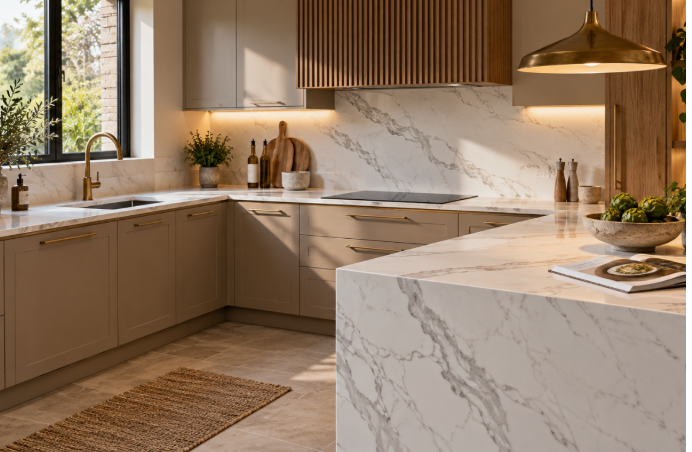
Kitchen and bathroom surfaces need to balance appearance with everyday practicality. Worktops are exposed to spills, heat, food preparation, cleaning products, and frequent use, so material choice can influence both maintenance and long-term performance. Quartz countertops are popular because they combine a consistent engineered surface with a wide range of colours, patterns, and finishes suitable for both traditional and contemporary interiors.
Before choosing quartz, it helps to understand how it is made, how it compares with natural stone, what maintenance it requires, and which design factors can affect the final result.
What Are Quartz Countertops?
Quartz countertops are engineered surfaces made primarily from natural quartz minerals combined with resins, pigments, and other materials. Unlike slabs of granite or marble, quartz worktops are manufactured to create more consistent colour and pattern.
This controlled production process allows manufacturers to offer surfaces that resemble natural stone while also providing more predictable appearance from slab to slab.
Because quartz is non-porous in most applications, it does not generally require the same sealing routine associated with some natural stones.
Why Are Quartz Countertops So Popular?
One of the main reasons homeowners choose Quartz countertops is their combination of durability and low maintenance.
The surface is resistant to many everyday stains when spills are cleaned promptly. Its non-porous structure also makes routine cleaning relatively simple, since liquids are less likely to penetrate deeply into the material.
Quartz is also available in a broad range of styles, from plain neutral tones to patterns inspired by marble and other natural stones.
This makes it easier to coordinate with cabinets, flooring, splashbacks, and kitchen hardware.
How Durable Is Quartz?
Quartz is a hard and durable material, making it suitable for busy kitchens and bathrooms.
However, durability does not mean the surface is indestructible. Heavy impacts can chip exposed edges, and excessive direct heat may damage the resin content within the slab.
For this reason, trivets or heat-resistant pads should be used beneath hot cookware.
Sharp knives can also damage both the surface and the blade itself, so cutting boards are recommended for food preparation.
With sensible daily use, Quartz countertops can maintain their appearance for many years.
Are Quartz Countertops Easy to Clean?
Routine care is generally straightforward.
Warm water, a soft cloth, and mild detergent are usually sufficient for everyday cleaning. Harsh abrasive cleaners should be avoided because they can dull the finish over time.
Spills from coffee, wine, sauces, oils, and other strongly coloured substances should be wiped up promptly.
For dried residue, a non-abrasive cleaning method is preferable to aggressive scraping.
Because quartz is engineered to be non-porous, it typically does not require periodic sealing, which can make maintenance easier than some natural stone surfaces.
How Do Quartz Countertops Compare With Granite?
Both quartz and granite are popular worktop materials, but they differ in important ways.
Granite is a natural stone, so every slab has unique veining, colour variation, and mineral patterns. Quartz is engineered, which allows greater consistency in appearance.
Granite often requires periodic sealing depending on the stone and finish, while quartz generally does not.
Quartz also offers a wider range of controlled colours and patterns, which can make it easier to match a particular design scheme.
However, both materials are durable and can perform well when installed and maintained correctly.
Which Colours Work Best in Modern Kitchens?
Colour choice depends on cabinetry, room size, lighting, flooring, and the overall design style.
Light-coloured Quartz countertops can make smaller kitchens feel brighter and more open. White and pale grey surfaces are especially common in modern designs.
Darker quartz can create contrast against lighter cabinetry and may work well in larger spaces.
Warm beige, cream, or stone-inspired shades can soften the appearance of contemporary kitchens and blend well with wood finishes.
Homeowners should view physical samples in their own lighting whenever possible, since colours can look different under natural and artificial light.
What Edge Profiles Are Available?
The edge profile affects both appearance and practicality.
Simple straight or slightly rounded edges suit modern kitchens and are generally easy to maintain. More decorative profiles can suit traditional cabinetry but may require additional fabrication.
The thickness of the slab also influences how substantial the finished worktop appears.
When selecting Quartz countertops, edge design should be considered alongside cabinet style and overall kitchen proportions rather than chosen separately.
Are Quartz Countertops Suitable for Islands?
Yes, quartz is frequently used on kitchen islands because it provides a continuous, durable work surface.
Large islands may require more than one slab depending on dimensions, so seam placement should be discussed before fabrication.
Quartz can also be used for waterfall edges, where the material continues vertically down the side of the island.
This creates a more architectural appearance, though it also requires accurate fabrication and installation.
What Should You Know About Installation?
Professional measurement and fabrication are important because quartz slabs are heavy and must be cut precisely around sinks, hobs, taps, and other fixtures.
Cabinets should be level and properly supported before installation.
Seams should be planned carefully, particularly in large kitchens or L-shaped layouts.
Because Quartz countertops are manufactured to exact dimensions after templating, changes to cabinetry or appliance positioning after measurement can create fitting problems.
Final layouts should therefore be confirmed before fabrication begins.
Conclusion
Quartz can provide an effective balance of durability, low maintenance, and design flexibility. Colour, pattern, edge profile, slab thickness, and installation quality all influence the final appearance and long-term practicality of the surface. Homeowners looking for warmer, softer tones may also consider a Crema quartz worktop when they want a neutral surface that complements wood, cream, beige, or other warm-toned cabinetry. This type of colour can create a more inviting alternative to cooler white or grey finishes. With careful planning and proper installation, Quartz countertops can offer a practical and visually versatile surface for both kitchens and bathrooms.